

5 Takeaways From My Interview With President Obama
In his first conversation since Trump posted a racist image of him online, President Obama talked about the state of the discourse, how to rebuild the party, and how the Democrats can move forward.

Last week I had the honor of hosting President Obama on my podcast.
To get personal for a minute, I got into politics because largely because of Obama. I think a lot of millennials did. Everyone knows exactly where they were when he won in 2008. People were out in the streets. The excitement was palpable. There was such a feeling of hope for what would come next.
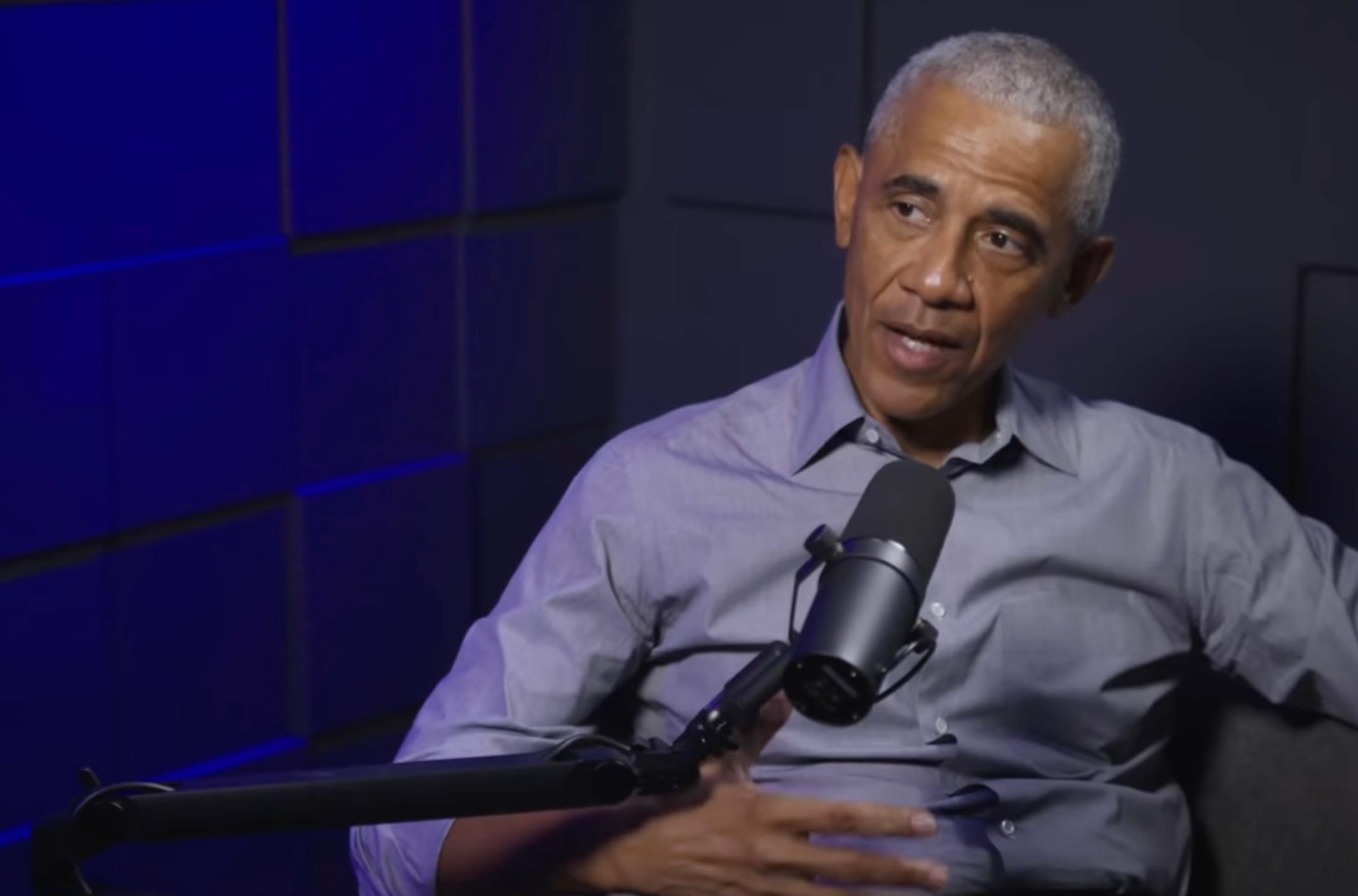
Obama mobilized a generation to work toward a common goal for a greater good in a way we haven’t seen since. And something I found when I sat down with him is that despite everything that’s happened in the last 10 years - despite the political chaos and the slide towards autocracy and the chipping away at democratic norms - he still believes it’s possible to do that again, and he makes you feel like it can be done, too.
Here are the five biggest takeaways from my conversation with President Obama.
Ignore the Noise
We kicked off the conversation with a discussion about how political discourse has devolved. Trump just recently posted a racist video of Obama. Republicans not only allowed it, they embraced it. He put things into perspective. Despicable behavior gets clicks and it drives headlines. In the media and online there’s no sense of shame or decorum or basic human decency.
But the majority of Americans don’t live online. And the media is, as he put it, a “clown show,” that feeds on attention. The reality on the ground is that most Americans don’t approve of it, they don’t want this, and they’re not like that. Don’t let the show fool you. Obama pointed to what’s going on in Minnesota. People organizing, community building, and fighting for their neighbors, and for the right to free speech. They’re fighting for the foundation of democracy.
“As long as we have folks doing that, I feel like we’re going to get through this.”
Commitment to Pragmatism
Obama has always been relentlessly focused on coalition building. The reality is that using the levers of government to move the country in the right direction is about putting together majorities - even among disparate groups - to pass and implement laws. We hear it ten times a day, “this is a nation of laws.” Well, for that to be true, you have to pass them. And the real work for Democrats, if we want to pass laws that make life better for average Americans, is to persuade and to convince.
If you’ve spent any time online - especially in the leftwing media ecosystem - infighting among those on the left is about as common as the sun rising each morning. Most days, you’d be hard pressed to tell whether it’s 2016 or 2026 based on the intraparty discourse online. But if we’re going to win and implement any policy, it becomes a question of what binds us together versus what separates us. While that message might seem futile, it’s essential as we head toward 2028.
What We’re Fighting For
Democrats, who believe in government, have the harder job to do. Being in the minority means it’s an uphill battle every single day. But the Republican majority hasn’t actually gotten much done. Obama pointed out that they’ve been ruthlessly effective at tearing things down. But they do not build. They have barely passed a single piece of legislation. They haven’t codified or institutionalized much of anything.
It’s easy to say the only way to beat them is to join them, get in the mud, slash and burn. But that is counterproductive to the preservation of democracy.
“If that’s how we fight, then we lose what we’re fighting for.”
Obama reminded me that what’s important is - in our desire to fight fire with fire - not to become the very thing that we’re fighting against. We can both ruthlessly exercise power and be virtuous in how we do it.
Find a Way to Get to “Yes”
Since Obama’s presidency, the Democratic Party has largely lost the energy and the inclusiveness that drew me and my generation into politics in the first place. It’s as if we’re looking for reasons to say “no” to people - the ideological litmus tests, identity politics - rather than finding any reason to say “yes, come on in.”
Something Obama reminded me about was that feeling of joy we had in those early days. The campaign was fun. It gave people a sense of community and meaning. One of the most powerful strategies we have is to bring that back. And we have to build that bench of new talent in the party.
“Our job as leaders is to lift up other leaders, to empower others, to find their gifts and help them exercise those gifts.”
There are Many Paths to Success
I talk about the absolutely maddening gridlock within the Democratic party all the time. We are often our own worst enemies. Factions within the party are working against each other even as democracy crumbles around us. Obama clarified something for me. Those arguments within the party aren’t about core values. They’re about tactics. Democrats fundamentally want to work to make things better for Americans. The arguments are over how to do it.
The most strategic thing we can do is to accept that there’s more than one way. Obama, pragmatic to his core, urged us to accept that different tactics are going to work in different places: Zohran Mamdani runs a brilliant, grassroots, socialist campaign that can absolutely win in New York City. That approach can’t win in, say, Virginia, where Abigail Spanberger’s more centrist campaign succeeded.
We need to think outside the box. Understand that this party represents all different kinds of people. That’s coalition building. That’s the job. That’s how we get there.
One Last Thing…
This conversation was extraordinary for so many reasons, not least of all because of the fact that it happened here. Mainstream headlines said “Obama speaks for the first time since… on a podcast.” Legacy media is playing catch up with independent outlets like this one.
Just a few years ago, a conversation of this magnitude would probably have gone straight to CNN or the New York Times or MSNBC. It’s telling that Obama, a generation-defining former president, now comes to an independent creator on YouTube.
I firmly believe that this is a turning point. It speaks to the power of independent media. And I hope that you’ll support this outlet as we continue to reflect the values that you’d like to see in our politics.
Your interview was EXCELLENT! You had great thought provoking questions that provided answers deeply helpful to all of us. Thank you Brian for your hard work and for keeping your journalism professional, tight, honest, and full of integrity.
You had a great interview. I’m so glad Obama sat down with you.